
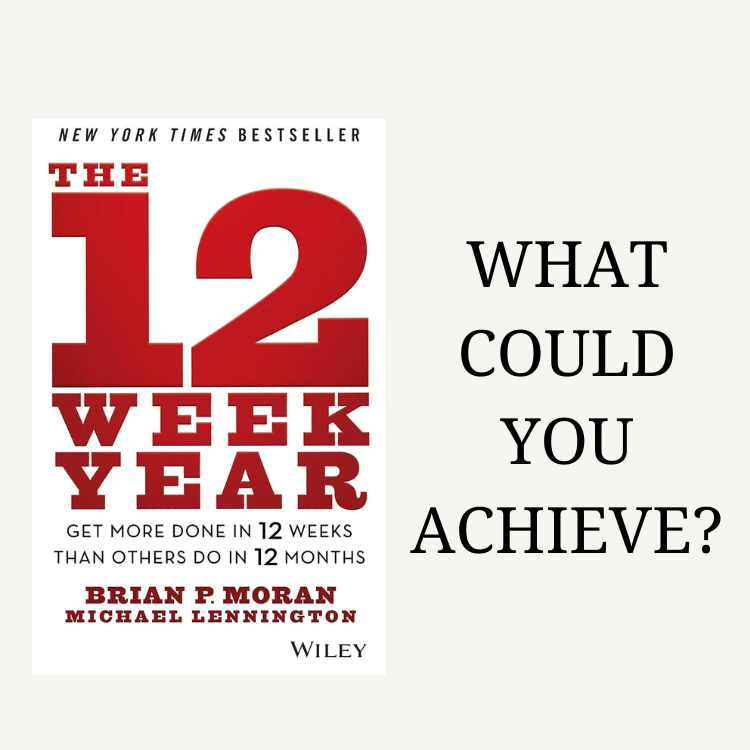
The book in 3 sentences
Achieve in 12 weeks what most people achieve in 12 months while following a good plan in the direction you want your life to go.
Every single moment is important, don’t waste a single one.
Who should read it?
Anyone who feels behind in life or with their goals and dreams.
Anyone that starts each year with a ton of New Year’s resolutions and by February has abandoned them and is feeling frustrated.
How the book changed me
Well I read this book at the end of 2023-start of 2024 so I’m still in the beginning stages of the change. So far, it’s been interesting. I will keep you updated.
My TOP 3 quotes
“The fact is every week counts! Every day counts! Every moment counts! We need to be conscious of the reality that execution happens daily and weekly, not monthly or quarterly.”

“Without a compelling vision, you will discover there is no reason to go through the pain of change.
“Behind every impossible achievement is a dreamer of impossible dreams.” —Robert K. Greenleaf
Vision is the starting point of all high performance. You create things twice; first mentally, then physically.”

“The results are not the attainment of greatness, but simply confirmation of it. You become great long before the results show it. It happens in an instant, the moment you choose to do the things you need to do to be great, and each moment that you continue to choose to do those things.”

Summary & Notes
Forget about annual thinking and planning
When most of us plan annually, we are relaxed at the start of the year because we still have time to achieve our goals. It’s when we get to year-end that we push like crazy to achieve them or, worse, abandon those goals completely.
When we switch to the 12 week year, it creates a sense of urgency, where every moment matter. We can’t relax and think we can do it later, because we can’t.
There are 5 disciplines to follow if you want to achieve your goals with the 12 week year: vision, planning, process control, measurement and time use. You can find them explained underneath.
Create your vision
You need to find a vision that motivates you on an emotional level to be able to work for it. What do you want in life? What do you want people to read in your obituary?

Create your 12 week plan
Benefits of using a well established plan:
- It reduces mistakes.
- It saves time.
- It provides focus.
It’s easier to plan 12 weeks in the future than a whole year.
You need to establish concise goals. Example: “In next 12 weeks I want to save 1000 euros”, “In the next 4 weeks I will drink 6 glasses of water per day”
Once you have your goals, you need to divide them in tasks or tactics to follow. Example: If you want to save 1000 euros in this 12 week year, how much do you have to save per week? How much do you have to save of each paycheck you receive? What saving habits do you have to implement?.
Process control
Once planned, you have to divide those tasks and tactics on each week (migration on bullet journal method). And then, at the start of each week, you have to plan it. Maybe the week before you didn’t do something that is necessary to continue, you have to add that task to this week, maybe move other things around.
This should take you around 15-20 min at the start of each week and 5 minutes for the daily planning at the start of each day.
Measure your results
You should measure your results on a weekly basis as well as in a 12 week year basis. Once you have measured your performance of a week you can adjust so the next week goes more smoothly, same with our short years.
This is easy to say but hard on the ego to do. You don’t have to do everything perfectly, the important part is getting better and better.
Time use
In the book 12 week year we find three types of time blocks:
- Strategic blocks: 3h of uninterrupted time for important and money-making tasks. 1 strategic block per week is usually enough.
- Buffer blocks: Buffer blocks: 30 minute block to deal with unplanned and low-value tasks such as deleting email.
- Breakout blocks: 3h of time on work timetable to do any activity you like. You can go on a hike, shopping, etc when you would usually be working.
3 main principles
Accountability: We always have the choice to do something or not, we own our actions, good or bad.
“It is this freedom of choice that is the foundation of accountability. The ultimate aim of accountability is to continually ask one’s self, “What more can I do to get the result?”.”
- Tips to create better accountability:
- Resolve to never be the victim and focus on the things you can control.
- Stop feeling sorry fo yourself. Learn to manage your thinking and don’t fall int self-pity, or worse, depression.
- Be willing to take different actions if you want different results.
- Surround yourself with “accountables”
Commitment: Keeping your own promises to yourself. Commitment is future accountability, owning your future actions.
Greatness in the moment: Live now, don’t rush life. Enjoy each moment, and then you will be more effective, you will enter “the zone.”
“Most people are running so fast, they miss life. They are in one place physically and another place mentally. You are most effective when you are mentally where you are physically—when you are present in the moment. Athletes call it “playing in the zone.” When you’re present in the moment, your thinking is clear and focused, decisions come easily, and you move through tasks almost effortlessly. When you are in the moment, you live with grace and ease. When you are totally present in the moment, when you connect with the now, life is more enjoyable.”

 HEART, MIND & GUT
Leave a comment