
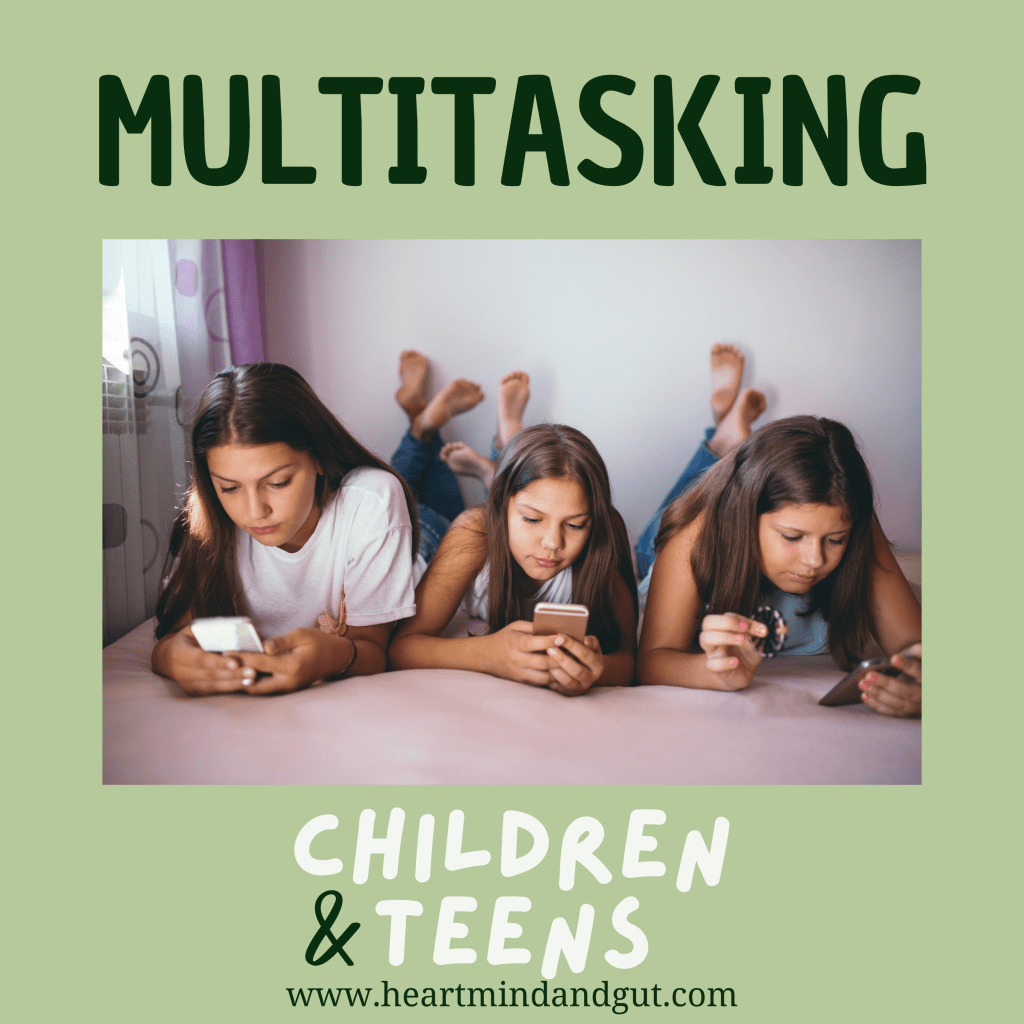
What’s multitasking?
If you look up the definition of multitasking, it says it’s the act of doing more than one thing simultaneously. In practice, multitasking doesn’t exist. Multitasking is impossible for our brain. Our brain is just switching really, really fast between tasks.
We have something called attention residue. Attention residue is the part of our brain we leave behind with each task we leave unfinished. This means that each time we switch between tasks, we lose focus and brain capacity. Some people even lose IQ points while multitasking.

Multitasking releases cortisol, the fight-or-flight hormone for the long run with side effects like inflammation, weak immune system, high blood pressure, high blood sugar, altered circadian rhythm (sleepless nights and falling asleep during the day), osteoporosis, and more. We shouldn’t expose our children to these health problems.
Multitasking also releases dopamine, because we feel like we are accomplishing a lot of tasks. Those releases of dopamine make our children addicted to multitasking from a young age. Making it harder later to quit multitasking. (1)
Just as multitasking affects adults, it affects children and teens.
What’s media multitasking?
There is one kind of multitasking that really popular in our youth and that’s media multitasking.

Media multitasking is simultaneously engaging in two or more types of media or using media while engaging in non-media activities. (2) You can say it’s attending a lecture while texting or online shopping, watching TV while on TikTok or Instagram, pretty sure you understand it.
USA youth spend 7,5 hours per day looking at some kind of screen and 29% of the time media multitasking. That’s a lot of time.
The effect of media multitasking in learning
There are some positive effects of multimedia time for children like better vocabulary, educational value, learning about other cultures and languages. Consider that these benefits only apply to children older than 2 years and when the quality of the content is excellent. Children under two years old aren’t able to understand what’s real and what’s represented like the TV.

On the other hand, the negative effects outweigh the positive ones. Children that are exposed to screens have difficulties with speech, language, motor skills, cognitive and social development. I would say the vocabulary gain is less valuable than language, for starters. And those children that use spell auto-correction, have difficulties spelling and cannot find mistakes. (3)
When children are watching some kind of screen, they are losing valuable time to learn other things and to spend time with their parents. Spending active time with adults is essential for a correct child development.

In people between 7 and 29 years-old, media multitasking increases as we age and we are “better” at it, and then declines. This can be because of multitasking “training” (improbable) or because just as multitasking increases, the cognitive development also increases, matching the rhythm.
We can observe the impact of media multitasking in learning in teens and college students that text or scroll through social media in class or while making homework have lower GPAs (Grade Point Average) than those that don’t media multitask. Not only that, but:
- Lower test performance
- Worse information recall (memory)
- Worse comprehension
- Sloppy Note-taking (4)
- Possibility to develop ADHD (5)
Media multitasking and mental health in youth
Social Media may influence development of depression through:
- Loss of protection (children and teens are exposed to things they should know)
- Poor sleep (scrolling until late or worried because of whatever they have seen)
- Self-comparison to the crazy and unattainable standards set by social media
- Stereotyping
- Anxiety-provoking content

Girls have lower odds of developing depression because of the media (not only social media, TV and ads included) because they are more prone to go with their worries to friends, parents or professionals while boys use TV, video games and social media to cope. These boys will later on express symptoms of depression when more stressors appear and there is no way to cope. Both boys and girls see a lot of unattainable role models on the internet. Most of them don’t really exist and are jus edits. (6)
Depression is not the only mental health problem associated to media multitasking, there is also ADHD. We know that media multitasking is related to ADHD but it is because of the media consumption or the multitasking aspect of it?

The connection between social media use and ADHD is weak, while the connection between multitasking (media or not), is strong. Therefore, we know that multitasking can lead to ADHD. (7)
How much screen time is too much for my child?
I’m not saying they shouldn’t watch any kind of screen in their life, they shouldn’t stay with their nose attached to it.
According to the WHO (World Health Organization) the children under 2 shouldn’t watch any screen, and those from 2 to 4 years old shouldn’t have over 1 hour per day of screen time, the less the better. (5)
And according to the Centers for Disease Control and Prevention (CDC), they should have as maximum:
| Age | Screen Time |
| under 2 y/o | no screen time |
| 3-7 years old | 0,5-1 hour |
| 7-12 years old | 1 hour |
| 12-15 years old | 1,5 hours |
| over 16 years old | 2 hours |
Remember than the less the better. (6)
Tips for reducing multitasking and media multitasking.
I have worked with both children and teens and I know how crazy addicted they are to their phones, even more if they don’t have the best environment at home. The change can be hard, but it’s worth it.
1. Be a good role model
Your children watch you and learn from you. If you do something, they will copy it. Moreover, if you do something and tell them not to do something you do, they won’t listen to you, as it’s hypocritical. In this case, that means not binge watching TV or scrolling non-stop and even less media multitasking.

2. Establish Media guidelines
Create a time for “screen time“, after all their other activities are done. Media time shouldn’t disturb necessary things as homework, meals, sleep and physical activity.
Don’t leave the TV or You Tube playing while doing other things, even if nobody is paying attention to it.
3. Create media-free zones
It’s recommendable to avoid media in the bedrooms (all the family) as it hinders sleep. The only device allowed in the bedroom should be a computer for homework, if necessary.

Another excellent media-free place is the dining table, watching TV or scrolling while eating counts as media multitasking. Multitasking while eating can push us toward an eating disorder.
4. Share their media time
Watch TV, play video games or interact in social media together. You can also install a parental control tool to limit time and certain topics.
5. Practice Mindfulness with them
Mindfulness is being able to live in the present moment, not remembering the past nor expecting the future.

Mindfulness is a great tool to master for everyone, including children. Some benefits of practicing mindfulness with children are:
- Better focus and attention with more participation in class
- Better self-control
- Improved academic performance
- More empathy and ability to resolve conflict
- Improved overall well-being
- Lower stress, depression and anxiety, therefore, lower disruptive behavior (8)
6. Find alternatives to screen time
Remember that while doing other activities, they aren’t attached to their phone.
Nowadays, there are tons of really cool board games parents can play with children or children can play with other children.

Drawing and painting are always a good way to spend time, plus it allows us to practice mindfulness by staying in the present.

Taking a walk outside and enjoying nature together is awesome for children and teens. You can discover together different species of animals and plants.

7. Practice doing one task at a time or monotasking
Whatever it is, one task at a time is much more efficient that all at the same time.
Their brains are forming. Every time we do something, our brain makes that neuronal connection stronger and stronger. If we do things one way over and over, afterwards is way harder for them to change their habits. If we can help them make the best connections for their health, awesome.
Now that we have seen how detrimental are multitasking and media multitasking for our children and teens, we should do everything we can to save them from the multitasking addiction.
I know some of these changes can be difficult to implement, but the sooner the better.
Here you have a completely free screen time checklist printable both in PDF and in Canva so you can edit it.
If you enjoyed the post, share it!
Sources
References
- Engelke, Tim. “Why Multitasking Is Far Worse than You Might Think.” Medium, Medium, 9 Sept. 2020, www.timengelke.medium.com/why-multitasking-is-far-worse-than-you-might-think-6148f145a194.
- Matthews, Natasha, et al. “Media-multitasking and cognitive control across the lifespan.” Scientific Reports, vol. 12, no. 1, 14 Mar. 2022, https://doi.org/10.1038/s41598-022-07777-1.
- Karani, Nazeera F., et al. “The influence of screen time on children’s language development: A scoping review.” South African Journal of Communication Disorders, vol. 69, no. 1, 10 Feb. 2022, https://doi.org/10.4102/sajcd.v69i1.825.
- May, K.E., Elder, A.D. Efficient, helpful, or distracting? A literature review of media multitasking in relation to academic performance. Int J Educ Technol High Educ 15, 13 (2018). https://doi.org/10.1186/s41239-018-0096-z
- “New Who Guidance: Very Limited Daily Screen Time Recommended for Children under 5.” WHO Guidance Limit Screen Time for Children, www.aoa.org/news/clinical-eye-care/public-health/screen-time-for-children-under-5?sso=y. Accessed 17 Mar. 2024.
- Muppalla, Sudheer Kumar, et al. “Effects of excessive screen time on Child development: An updated review and strategies for Management.” Cureus, 18 June 2023, https://doi.org/10.7759/cureus.40608.
- Fisher, Jacob T., et al. “Uncovering the structure of media multitasking and attention problems using network analytic techniques.” Computers in Human Behavior, vol. 147, Oct. 2023, p. 107829, https://doi.org/10.1016/j.chb.2023.107829.
- Staff, Mindful. Mindfulness for Kids. 11 June 2020, https://www.mindful.org/mindfulness-for-kids/.
 HEART, MIND & GUT
Leave a comment